How Gutters Protect Your Foundation and Basement From Water Damage
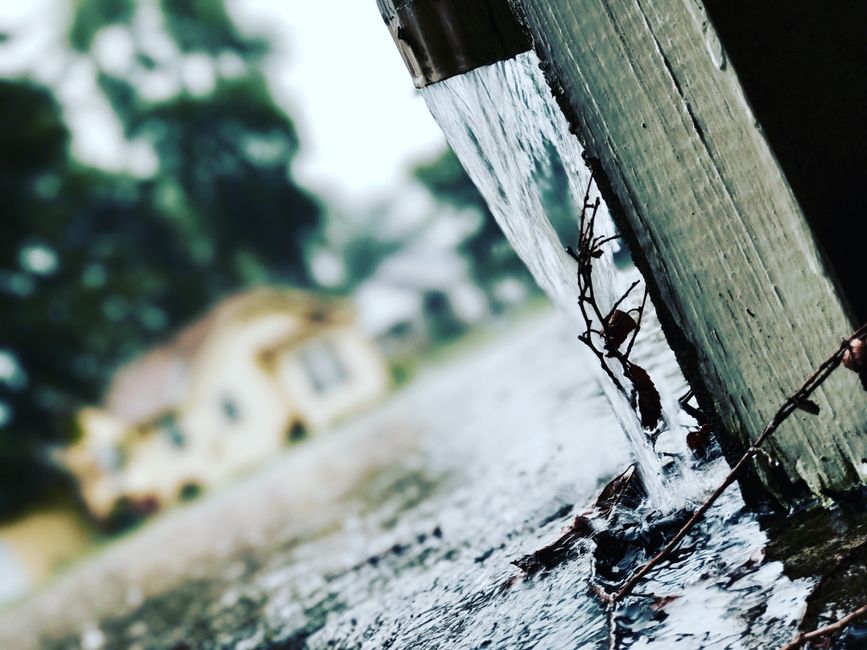
A roof sheds a surprising amount of water during a single storm, and every drop of it has to go somewhere. Without gutters, that water runs straight off the roof edge and drops in a line right along the base of the house — the same few feet of soil, storm after storm, year after year. Over time, that pattern is one of the more common contributors to foundation and basement moisture problems in homes throughout the Dubuque area. Understanding how seamless gutter installation fits into that picture makes it easier to see why gutter condition matters well beyond the roofline.
Where the water goes without gutters
Picture a heavy rain hitting a roof with no gutters. Water sheets off the edge and lands in a narrow band a foot or two from the foundation wall. Repeated over enough storms, that runoff saturates the soil right next to the house rather than draining away from it. Saturated soil next to a foundation behaves differently than dry soil — it expands, it holds water against the foundation wall longer, and it puts extra hydrostatic pressure on whatever is below grade, including a basement wall.
Gutters interrupt that pattern. Instead of letting roof water drop straight down along the foundation, a working gutter system collects it along the whole roof edge and routes it through downspouts to a point further away from the house — ideally several feet clear of the foundation, not just past the edge of the roof.
How this connects to basement moisture specifically
Basements sit below grade, which means the soil around them is already under more pressure than soil around a slab or crawlspace. When that surrounding soil is kept wetter than it needs to be — because roof runoff keeps landing right next to the wall — the basement wall is dealing with more moisture pressure than it would otherwise. Over time, that shows up as dampness, efflorescence (the chalky white mineral deposit left behind as water moves through concrete or block), or in more persistent cases, actual water intrusion during heavy rain.
None of this means gutters are the only factor in basement moisture — grading, window wells, and foundation drainage systems all play a role too. But gutters are one of the most direct and manageable pieces of that picture, because they control where a large volume of water goes before it ever reaches the ground near the foundation.
Why downspout placement matters as much as the gutter itself
A gutter that's collecting water properly can still contribute to foundation problems if the downspouts dump that water too close to the house. This is one of the more overlooked details in the whole system: a downspout that ends right at the foundation, with no extension or splash block, can concentrate a large volume of water in one exact spot — often worse than if there were no gutter at all, because now all the water from an entire roof section is funneled to a single point.
Getting downspout extensions, splash blocks, or grading right is part of what makes a gutter system actually protective rather than just decorative. It's also one of the details worth discussing whenever downspout placement is part of a new installation or an adjustment to an existing system.
Signs that gutters may be contributing to a moisture problem
A few patterns are worth paying attention to around the foundation and basement:
- Visible erosion channels or bare soil trenches near the foundation after storms
- Standing water or noticeably soggy soil close to the house after rain has stopped elsewhere in the yard
- Dampness, musty odor, or visible moisture on interior basement walls that tends to show up during or shortly after heavy rain
- Gutters that are visibly overflowing along one section during a storm, rather than draining evenly
None of these signs prove the gutters are the sole cause, but they're worth checking against gutter condition, downspout placement, and grading before assuming the problem is coming from somewhere else entirely.
Keeping the system working as intended
A gutter system only protects a foundation if it's actually moving water where it's supposed to. Debris buildup, sagging sections, and pulled-loose brackets all reduce how well a gutter collects and channels water, even if the gutter looks fine from the ground. Seasonal buildup of leaves and grit is a normal part of owning a home with mature trees nearby, which is a big part of why gutter condition is worth checking more than once a year in a wooded or tree-lined part of the Dubuque area.
Requesting a quote
If you're noticing signs of water pooling near your foundation, or you're not sure whether your current gutters and downspouts are routing water far enough away from the house, you can request a quote through this site to have the system looked at. Call 908-493-5028 or fill out the short form to get the conversation started.